Microfrontend Architecture: The Future of Scalable Web Development
Ready with your favorite snack🍇🍪? Architecture Snacks is about having a short break and learning something new. Let's dive in!

Have you heard of Microfrontend Architecture (MFE)? This comes up more more often in large enterprises, where companies builds a feature rich portals addressing business needs across a vast domain, making for a heavyweight frontend applications that are being continually developed and served to large group of internal users. Microservices architecture for backend part of the system have become a commonplace in the minds of engineers since quite a while, naturally one starts to think, that perhaps there is a way to manage complexity by breaking down chunky frontend portals in similar fashion. This leads us to Microfrondends.
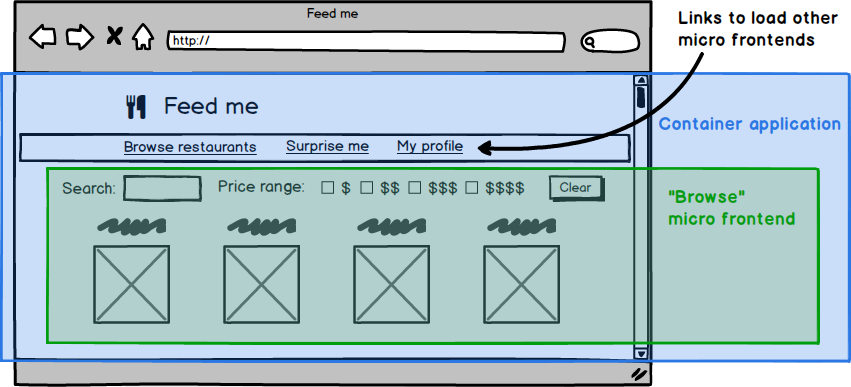
Typically, applying Microfrontend Architecture (MFE) to a Single Page Application (SPA) means the original web app is broken down into smaller, independent pieces, each responsible for a distinct feature of the application. Each piece, or microfrontend, is developed, tested, and deployed independently, often by separate teams. On a practical level, this could mean one microfrontend for the navigation, another for the user profile, and another for the shopping cart in an e-commerce application, each potentially using different technologies best suited for their specific needs.
To help you visualize, here is a pic from a wonderful in-depth article on Micro-frontends at https://martinfowler.com/:
When To Use MFE?
As mentioned above microfrontend architecture arose as a solution to the challenges faced in developing and managing large-scale, complex web applications. It emerged from the need to break down monolithic frontend codebases into smaller, more manageable pieces, similar to how microservices have done for the backend. The architecture aims to address issues such as:
scalability
team autonomy
technological diversity
By breaking down a monolithic frontend into microfrontends, different teams can work independently on different parts of the application, using the best technology for their specific needs. This can lead to faster development times, easier code management, and the ability to incrementally upgrade, refactor & deploy parts of the application. Therefore, if an existing monolithic frontend is becoming too large or complex to manage effectively, or if different parts of the application have different technical requirements - for example, one part of your application needs to be highly performant while another part needs to be highly secure - one might consider switching to a microfrontend architecture.
Ways To Implement MFE
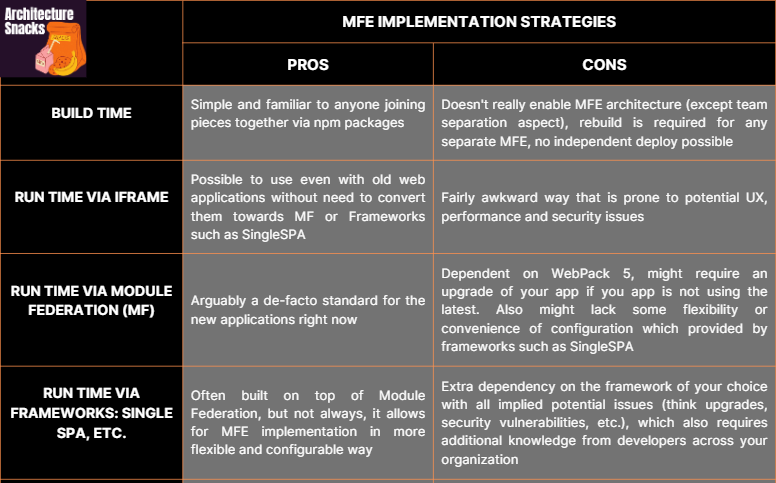
Implementing microfrontends for Single Page Applications (SPAs) can be achieved through several methods. Here are a few common approaches:
Build-Time Integration: In this approach, all microfrontends are integrated during the build process. Each microfrontend is developed and tested independently, and then they are all bundled together into a single SPA during the build process. This approach can be simple and efficient, but it doesn't allow for independent deployment of microfrontends.
Run-Time Integration via Iframes: Each microfrontend is developed as a separate SPA and then embedded into the main application using iframes. This allows for independent deployment of microfrontends, but it can lead to issues with user experience and performance.
Run-Time Integration via JavaScript: In this approach, each microfrontend is developed as a separate SPA and then loaded into the main application at runtime using JavaScript (see Module Federation for Webpack 5). This allows for independent deployment of microfrontends and can provide a better user experience than the iframe approach, but it can be more complex to implement.
Using a Microfrontend Framework: There are several frameworks and libraries available that can help with implementing microfrontends, such as Single-SPA or Open Components. These tools provide a structured way to implement microfrontends and can handle many of the complexities for you.
The Price We Pay For Increased Flexibility of MFE Architecture
Before using Microfrontend Architecture (MFE), developers and architects should be aware of following trade offs, or as I like to think about it, the price we pay for more flexible and scalable architecture (unsurprisingly many point are similar to trade offs introduced by microservices):
Increased Complexity: While MFE can help manage large-scale applications, it also introduces a new layer of complexity. Developers need to manage multiple, independent parts of an application, which can be more complex than managing a single, monolithic application.
Performance Issues: Each microfrontend might have its own set of dependencies, which can increase the overall size of the application and potentially lead to performance issues. It's crucial to look into dependency deduplication for an enterprise standard applications to ensure fast load times.
Consistency Challenges: Ensuring a consistent look and feel across all microfrontends can be challenging, especially when different teams are working on different parts of the application. Establishing design and development guidelines can help maintain consistency.
Testing and Debugging Difficulties: Testing and debugging can be more complex in a microfrontend architecture, as issues might only appear when all the parts are integrated together. Developers need to plan for this increased complexity.
Deployment and Operational Overhead: Each microfrontend can be deployed independently, which can lead to increased operational overhead. It's important to have a well-planned deployment strategy.
Handling Cross-cutting Concerns: Cross-cutting concerns like authentication, state management, and routing can be more complex in a microfrontend architecture. These issues need to be carefully planned for.
Conclusion
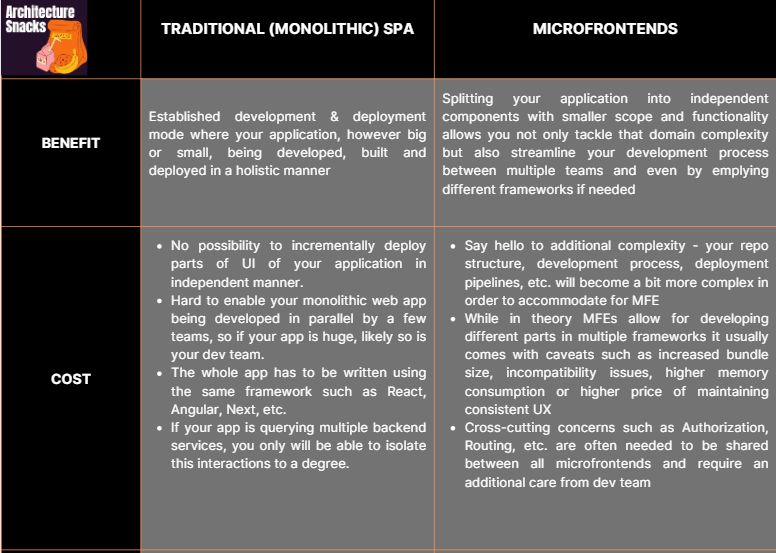
As usual, below is a high level summary regarding MFE architecture pros and cons, in a tabular form for easy reference: